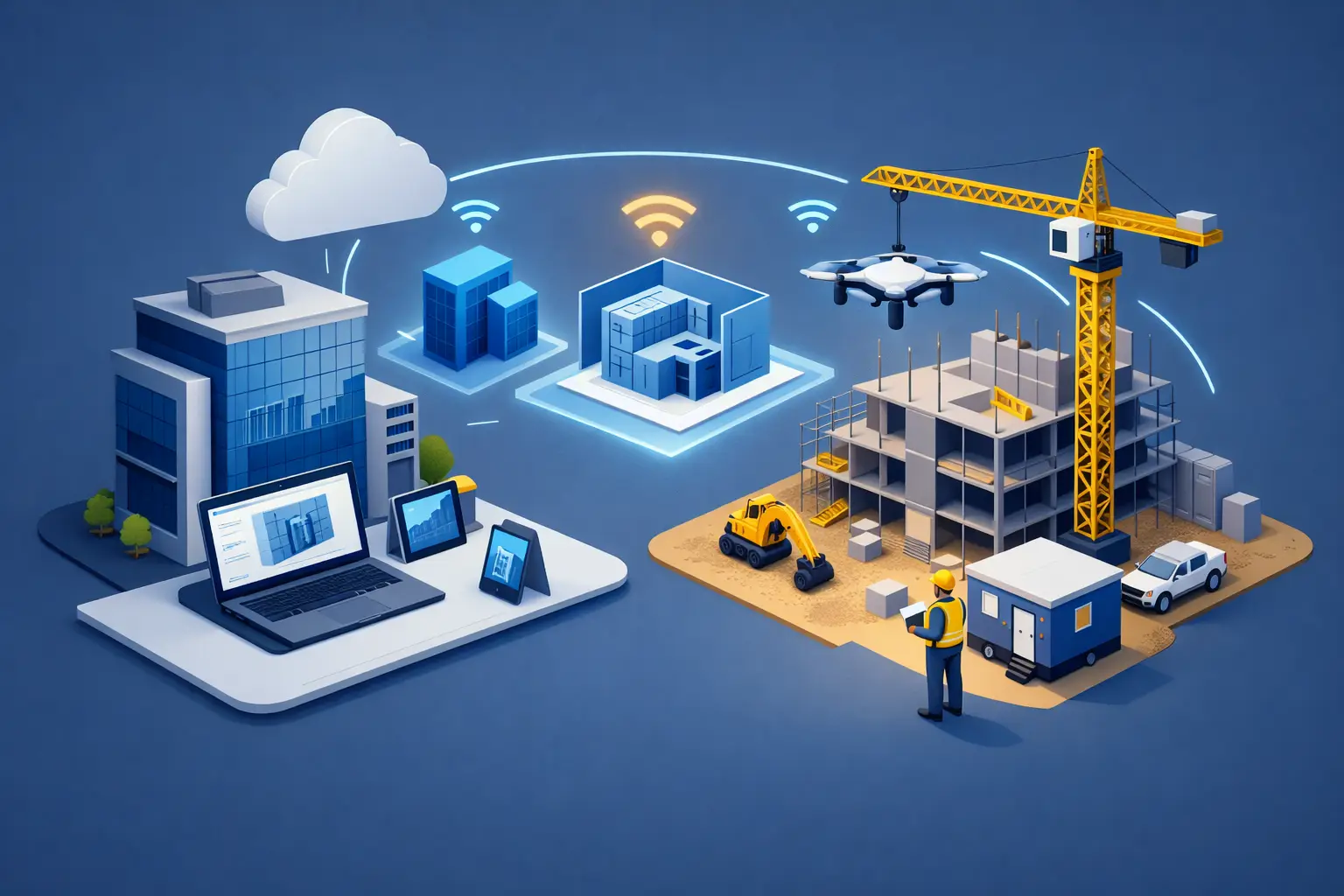
A superintendent is waiting on revised drawings, the project manager is trying to approve a change order from the trailer, and the field team is uploading site photos over a weak cellular signal. That is where jobsite connectivity stops being a convenience and starts affecting schedule, cost, and risk.
For AEC firms, jobsite connectivity is now tied directly to execution. It supports plan access, document control, field reporting, VoIP, cameras, safety systems, equipment tracking, and communication between office and field teams. When it is unreliable, people create workarounds. Workarounds may keep the day moving, but they also create version-control problems, security gaps, and expensive delays.
What jobsite connectivity really means
Jobsite connectivity is more than getting an internet signal to a trailer. It is the ability to keep people, devices, systems, and project data reliably connected in a changing physical environment. That includes temporary offices, open sites, multi-phase builds, rural locations, dense urban interference, and teams moving between field and office.
For construction and engineering operations, the challenge is that the environment never stands still. Materials move, walls go up, equipment shifts, subcontractors come and go, and bandwidth demand changes by phase. A setup that works during site prep may fail once the structure changes or more trades come online.
That is why jobsite connectivity should be treated as an operational system, not a one-time utility order. It needs planning, monitoring, security controls, and room to scale.
Why jobsite connectivity has become a business issue
Ten years ago, many field workflows could tolerate spotty access. Teams could call the office, print more sets, and handle updates later. That margin is shrinking fast.
Today, project teams depend on cloud-based project management platforms, digital submittals, BIM coordination files, time tracking, mobile inspections, and connected devices in the field. The more digital the workflow becomes, the more a weak network creates immediate downstream impact.
A delay in syncing one file can lead to crews working from outdated information. A dropped connection during a remote coordination meeting can slow decisions across multiple stakeholders. An unsecured hotspot can expose project data or create a path into the wider business network. These are not isolated IT annoyances. They affect productivity, accountability, and client confidence.
For CFOs and operations leaders, the financial side is straightforward. Downtime in the field is labor cost without output. Rework from communication failure is margin erosion. Security incidents can become legal, contractual, and reputational problems. Reliable connectivity protects all three.
The most common reasons job sites fail
Most connectivity problems are not caused by one dramatic failure. They usually come from small planning gaps that compound under field conditions.
The first issue is assuming carrier coverage equals usable performance. A site may show strong coverage on paper but still struggle because of terrain, building materials, local congestion, or competing equipment. Cellular is often part of the answer, but it is not automatically enough.
The second issue is designing for internet access only, rather than for the actual workload. A trailer with email and web browsing has one profile. A site running cloud file sync, cameras, voice traffic, and multiple subcontractor devices has another. If the network is sized for the lighter use case, performance drops fast.
Third, security is often bolted on after deployment. Shared passwords, unmanaged devices, and informal guest access may feel practical at a busy site, but they create exposure. Construction environments already carry enough operational risk. The network should not add more.
The final issue is lack of ownership. When connectivity is nobody’s ongoing responsibility, problems stay unresolved until they disrupt the project. Temporary networks still need monitoring, support, and escalation paths.
What good jobsite connectivity looks like
A strong field connectivity strategy starts with reliability, but reliability alone is not enough. The network also needs to match how AEC teams actually work.
That means multiple connection options where appropriate, not a single point of failure. It means secure access for employees, vendors, and guests without mixing all traffic together. It means enough bandwidth for field applications and enough visibility to know when usage patterns change.
Good jobsite connectivity also supports business continuity. If the primary circuit fails, there should be a backup path. If one device goes down, support should know quickly. If a site expands, the network should adapt without a complete redesign.
This is where mature IT planning matters. Temporary does not mean low stakes. In many cases, the job site is where critical decisions happen fastest and where bad information creates the most damage.
Security cannot be separated from connectivity
AEC firms often manage project documents, financial data, contracts, and communications across distributed teams. Job sites add complexity because the environment is more exposed and less controlled than a corporate office.
If jobsite connectivity is built around consumer-grade hotspots and ad hoc passwords, the business is relying on convenience over control. That may work until a compromised device connects, a shared password spreads beyond the intended team, or sensitive files move across an unprotected network.
A more disciplined approach includes segmented access, managed firewalls, secure remote connectivity, device policies, and monitoring. It also includes practical user controls. Field teams need simple, dependable access methods, not security policies so cumbersome that everyone bypasses them.
The goal is not to make the site harder to run. The goal is to reduce the chance that field operations become the weak point in the firm’s security posture.
How AEC firms should plan for jobsite connectivity
The right model depends on project type, location, duration, and digital requirements. There is no universal setup that fits every site.
A short-term urban project may rely on a blend of wired service and wireless failover. A remote infrastructure site may need a carrier-diverse wireless design with carefully managed bandwidth. A multi-phase commercial build may need infrastructure that evolves as the structure changes and the workforce increases.
That is why the planning process should start with operational questions, not hardware preferences. How many users will be on site? Which platforms are mission-critical? Will there be cameras, VoIP, smart devices, or large file transfers? Who needs secure access to what? What is the acceptable downtime threshold?
Once those answers are clear, the technology choices become more rational. More importantly, the business can align cost with actual project risk instead of overbuying in the wrong areas or underinvesting where failure is expensive.
Why managed oversight makes a difference
Job sites are not ideal places for reactive IT. If the network only gets attention after users complain, the project is already losing time.
Managed oversight changes that by putting monitoring, support, and security around the environment from the start. Performance issues can be identified earlier. Configuration changes can be controlled. Firmware, policy updates, and incident response can be handled within a defined process rather than through improvised fixes.
For firms with lean internal IT teams, this matters even more. Most AEC organizations do not want their internal technology staff driving from site to site to troubleshoot temporary networks while also managing office systems, cloud platforms, user support, and cybersecurity obligations. They need a model that extends their capability without sacrificing standards.
That is where a strategic managed services partner can add real value, especially one that understands AEC workflows and the difference between office uptime and field uptime. At 360 Smart Networks, that approach starts with the business requirement first, then builds security, support, and scalability around it.
The bigger payoff
Reliable jobsite connectivity improves more than internet access. It sharpens coordination, supports faster decisions, reduces rework, and gives leadership better confidence in field execution. It also strengthens the link between project delivery and the broader technology strategy of the business.
As AEC firms continue to digitize operations, the line between job site infrastructure and business infrastructure keeps getting thinner. Treating field connectivity as a strategic function is no longer overengineering. It is practical risk management.
If your teams are relying on fragile connections, shared hotspots, or one-off fixes, the issue is not just speed. It is whether your field operations have the foundation they need to perform consistently under pressure. That is the standard worth building toward.