
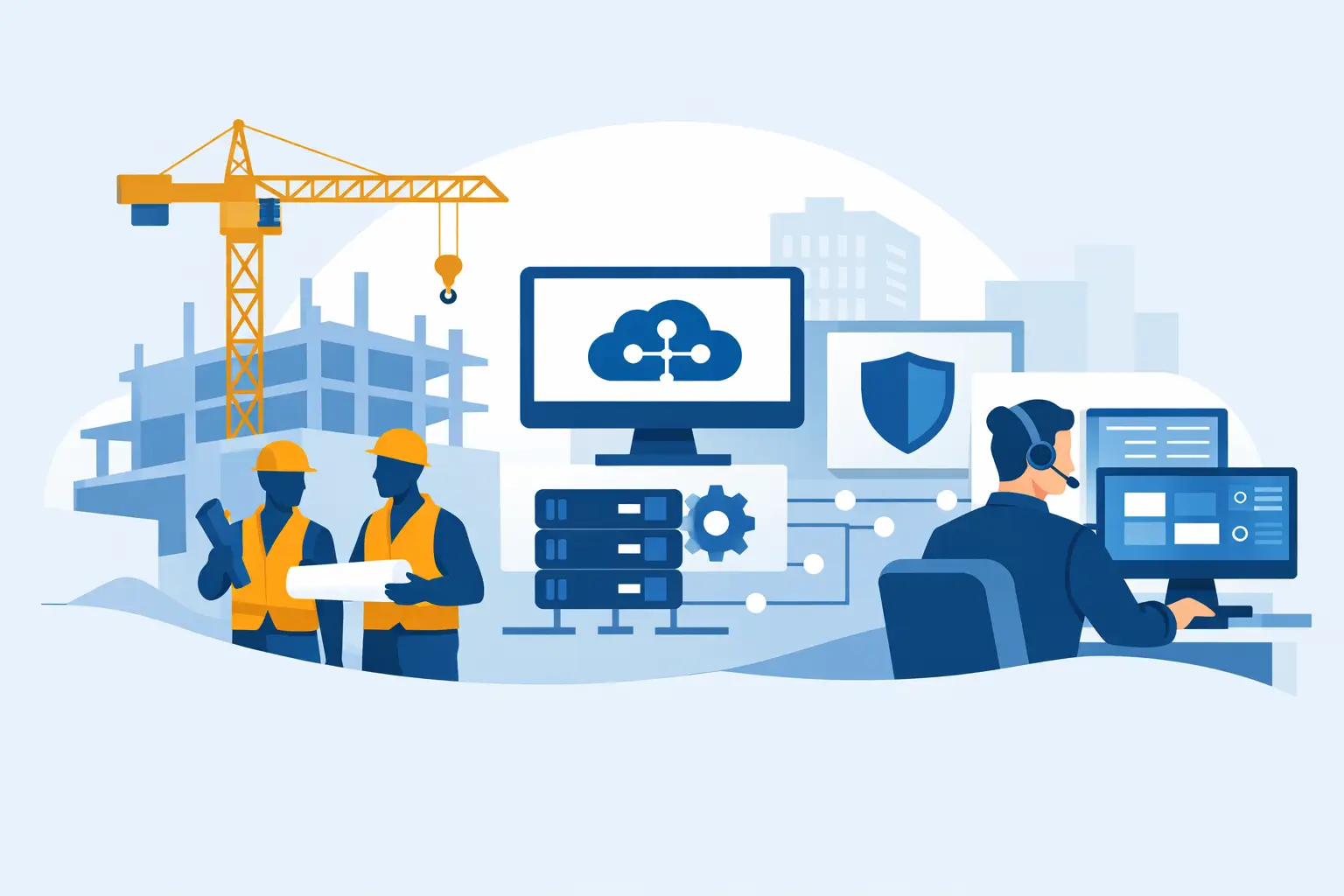
At 6:15 a.m., a superintendent is already on-site, a project manager is opening revised drawings from a tablet, and accounting is waiting on updated job cost data before the workday fully starts. If your systems are slow, disconnected, or exposed, the impact shows up fast. That is why choosing the right MSP for construction companies is less about fixing computers and more about protecting schedules, budgets, and client confidence.
Construction runs on coordination. Field teams, office staff, estimators, architects, engineers, and subcontractors all rely on accurate information moving at the right time. When technology breaks down, the problem is not just inconvenience. It can mean outdated plans in the field, missed approvals, invoicing delays, or a security incident that freezes operations when a deadline is already tight.
Why construction firms need a different kind of IT partner
Construction companies do not operate like a typical office-based business. They work across trailers, jobsites, headquarters, home offices, and mobile devices. Their software stack often includes project management platforms, accounting systems, document storage, estimating tools, and large design files that need to stay accessible without creating version-control problems.
That environment creates pressure points a generalist provider may miss. A construction firm needs stable connectivity between field and office, secure access to files from anywhere, and support that accounts for the reality of crews starting early and projects moving quickly. If your IT partner only reacts when tickets come in, you are already behind.
A strong managed services relationship should reduce downtime before it affects production. It should also address cybersecurity in practical terms. Construction firms are frequent targets for phishing, wire fraud, and ransomware because they move money, share contracts, and exchange sensitive project documents with many outside parties. An MSP that treats security as optional is not aligned with the risk profile of the industry.
What an MSP for construction companies should actually deliver
The right provider should start with business operations, not gadgets. That means understanding how project teams work, where delays happen, which systems are business-critical, and how disruptions affect revenue and reputation.
Reliable support for office and field environments
Construction teams need support that extends beyond the main office. Laptops in the field, tablets used for plans, mobile devices, printers in trailers, wireless networks, and cloud applications all play a role in day-to-day execution. If one part of that chain fails, work slows down.
An effective MSP should monitor systems continuously, respond quickly when issues arise, and standardize devices so they are easier to support. Standardization is not glamorous, but it matters. When every project team is using different hardware, software versions, and login practices, support becomes slower and risk increases.
Job site connectivity that matches real conditions
Some jobsites have strong connectivity. Others do not. Some teams can work fully in the cloud. Others need offline access and syncing because the environment is inconsistent. This is where experience matters.
A provider that understands construction will not assume every site can be treated the same way. They will plan for bandwidth limitations, device management, secure remote access, and the handoff between office-based systems and field use. The goal is not perfect technology on paper. The goal is dependable performance under real project conditions.
Security that protects money, data, and timelines
Construction companies manage contracts, payroll information, banking communications, architectural files, and project schedules. That makes them attractive targets. The most common threats are not always sophisticated. They often come through phishing emails, weak passwords, exposed devices, or poor access controls.
A qualified MSP should provide layered protection that includes endpoint security, email protection, multifactor authentication, backup and disaster recovery, user access controls, and ongoing monitoring. Training matters too. Many incidents start with a user clicking on the wrong message at the wrong time.
The trade-off here is cost versus exposure. Some firms try to keep security light to control spending. That may feel efficient until a single incident creates days of downtime, payment fraud, or a breach involving project data. For most growing construction businesses, basic protection is not enough anymore.
Where many IT relationships fall short
A lot of construction firms have some form of IT support today. The issue is that support alone is not strategy. If your provider only shows up when something breaks, you are paying for interruption, not continuity.
Another common problem is fragmented responsibility. One vendor handles internet, another manages phones, a freelance technician helps with devices, and no one owns the bigger picture. That setup often works until a project-critical application goes down or a cybersecurity event hits. Then everyone points in different directions while your team waits.
The better model is a single managed relationship with clear accountability. That does not mean one-size-fits-all service. It means someone is responsible for performance, security, planning, and day-to-day support in a coordinated way.
How to evaluate an MSP for construction companies
The smartest buying question is not, “How many tickets do you close?” It is, “How will you help us keep projects moving without unnecessary risk?”
Start by asking how the provider supports distributed teams. Construction firms need systems that work across offices, jobsites, and remote staff. If a provider cannot explain how they manage that environment, they may not be the right fit.
Ask how they approach cybersecurity. You want specifics on monitoring, backups, incident response, identity security, and user training. You also want to know whether they can support compliance expectations that may affect your contracts, insurance requirements, or client relationships.
Ask about planning. A credible MSP should not just support your current environment. They should help you think in phases – what needs attention now, what should improve over the next year, and how technology should scale with growth, acquisitions, new offices, or larger projects.
Finally, ask how they measure success. Good answers include reduced downtime, better response times, stronger security posture, smoother onboarding, and improved system reliability. Vague promises about being available whenever needed are not enough.
The business case: IT should protect margin, not drain it
Construction leaders often look at managed IT through the lens of overhead. That is understandable, but incomplete. The real comparison is not monthly service cost versus doing less. It is managed investment versus the cost of disruption.
One day of lost productivity across project management, accounting, and field coordination can create far more damage than a monthly service agreement. The same goes for ransomware, invoice fraud, or failed backups when critical data needs to be restored quickly.
A strong MSP helps control those risks while making everyday work more efficient. That can show up in faster onboarding, fewer recurring issues, more stable systems, and clearer technology planning. It also gives internal leaders room to focus on operations and growth rather than constantly chasing IT problems.
For firms without a deep in-house IT bench, this is especially important. You may not need to build a full internal department to get mature support, security, and strategic guidance. But you do need a partner that operates with that level of discipline.
What the right partnership looks like over time
The best managed services relationships get more valuable after the first few months. Once the environment is documented, systems are stabilized, and security controls are in place, the conversation can shift from reactive fixes to long-term performance.
That is where strategy matters. Technology decisions should support how the business wants to grow. Maybe that means improving cloud collaboration for project teams, tightening security around financial workflows, planning for a second office, or reducing the downtime that slows field execution. The point is alignment.
For AEC firms across the Southeast, that level of support often becomes a competitive advantage. When teams can access the right information quickly, communicate securely, and rely on stable systems, they work with more confidence and fewer interruptions. That affects internal efficiency, client service, and the ability to scale.
360 Smart Networks approaches this as a managed relationship built around uptime, security, accountability, and business planning. That model matters in construction because the stakes are operational, not abstract.
If you are evaluating providers, look past generic IT promises. The right MSP for construction companies should understand how your projects run, where your risk lives, and what it takes to keep work moving when deadlines, field conditions, and security threats do not wait.


